
A Visit to the FSB Factory in Brakel
Everything in Hand

© Christian Grund
Author: Ansgar Steinhausen
More than one million door handles leave the production facilities of Franz Schneider Brakel – FSB for short – each year. The company is the European market leader in the premium segment.
That trajectory was far from foreseeable in 1881, when the company was founded as Teutonia Werke, Westfälisches Metallwerk.
Initially, production focused on decorative aluminum sheets for the ornate furniture of the Gründerzeit era. It wasn’t until the 1920s that door hardware entered the portfolio. Under the influence of New Objectivity, these designs quickly became synonymous with the architectural avant-garde. For the architects of the Bauhaus and their contemporaries, the significance of functional door handles was more apparent than ever before.
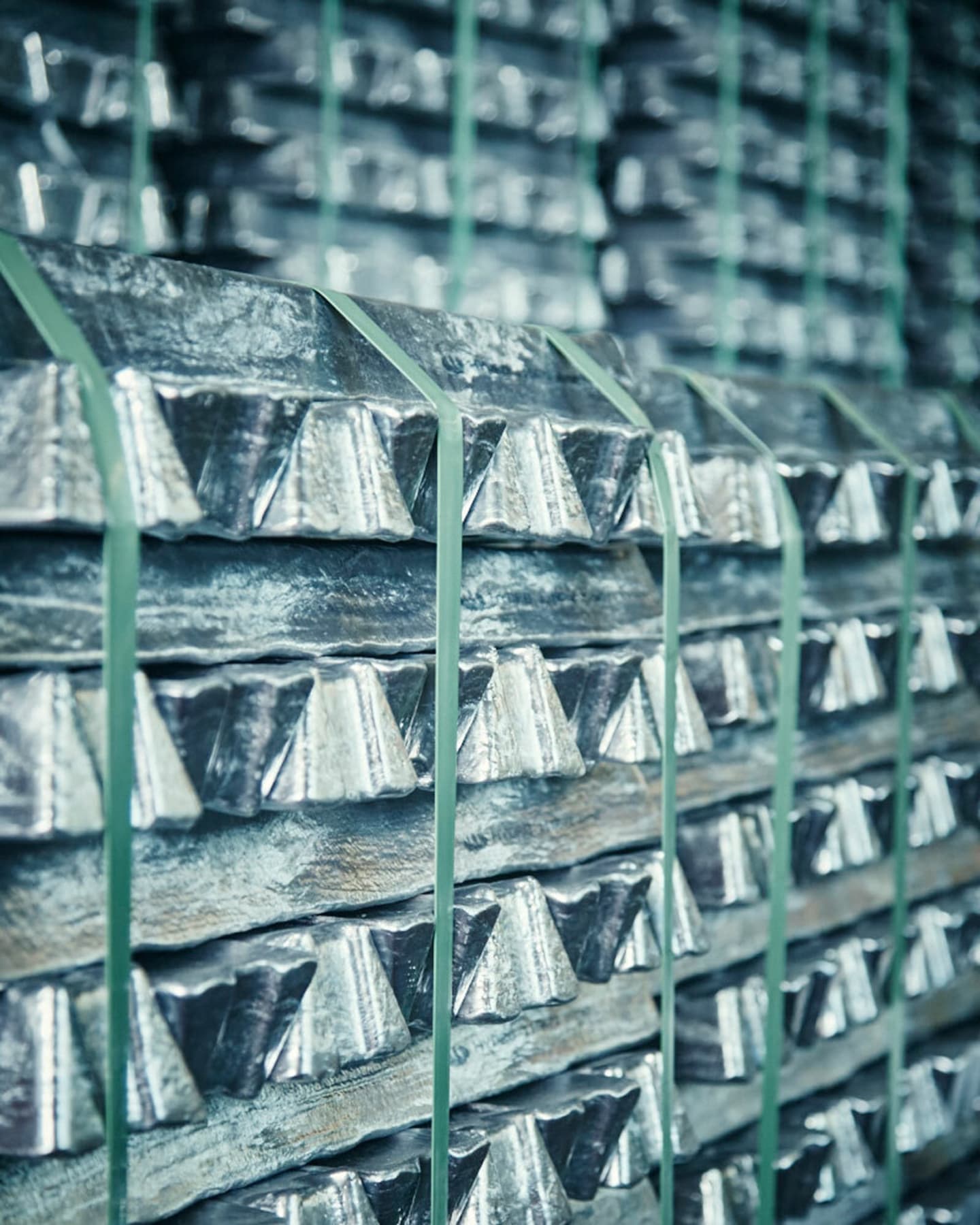
The photo shows so-called aluminum ingots. This is the form in which raw aluminum is delivered to Brakel.
© Christian Grund
The major breakthrough for FSB came with the construction boom of the 1950s. It was during this period that the first models emerged that could be described as “author designed” handles. “Up to that point, door handle design had largely been anonymous. Now it was attributed to individual designers, such as our then in-house designer Johannes Potente, and soon gained international recognition,” recalls former FSB Marketing Director Matthias Fuchs, a tall, bespectacled industrial design graduate.
Four of Potente’s designs were later even included in the permanent collection of the Museum of Modern Art in New York.
The material of the moment was aluminum: a remarkably versatile lightweight metal and a silver-toned promise of the future, capable of taking on both linear precision and fluid form. But the enthusiasm of the 1970s for plastics and bold colors pushed FSB into a period of crisis, until the brand regained its footing in the 1980s with new designs by leading architects and designers, increasingly embracing the refined material aesthetics of stainless steel and bronze.

Stainless steel being welded
© Christian Grund

An FSB employee grinding a stainless steel tube
© Christian Grund

Polishing of an aluminum component
© Christian Grund
While many manufacturers now outsource production to China – where stainless steel products have long become mass-produced commodities – FSB remains committed to its home in East Westphalia.
This commitment to quality in a high-wage country comes at a price. The most affordable aluminum door handle set from Brakel starts at €46, while the most exclusive bronze versions are priced above €300, with stainless steel positioned between the two. For that reason, FSB products are not found in hardware stores. Instead, their designs are created by renowned architects such as David Chipperfield, Helmut Jahn, Dominique Perrault, and Christoph Mäckler, alongside classics by Walter Gropius, Robert Mallet-Stevens, Ferdinand Kramer, and Max Bill.

Production impressions. Here, molten aluminum is ladled for casting.
© Christian Grund
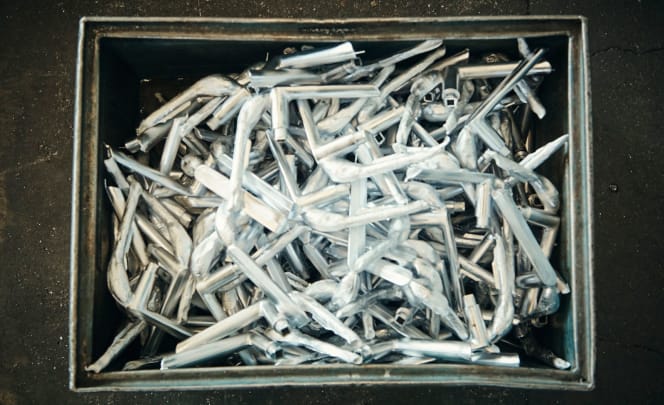
Freshly cast aluminum components
© Christian Grund
Before one of the masterfully crafted door handles can be held in your hand, many production steps are required. In the light-filled halls of a former steam slaughterhouse, one of the 600 employees ladles molten aluminum from a vat, leans over the mold, and pours the lightweight metal in with a motion practiced thousands of times. Seconds later, a silvery handle emerges from the tool. The piece is still rough and ridged at first. It is then ground repeatedly; free-form designs often by hand, while geometric shapes are handled by robots in a kind of angular, mechanical ballet.

Finished anodized aluminum components
© Christian Grund

In so-called hydroforming, parts are shaped under pressure.
© Christian Grund

A bronze door knob is being ground
© Christian Grund
In the vibratory finishing drums, an army of small ceramic cones then tirelessly rubs against the metal, and after many hours finally turn it into something smooth to the touch. Anodizing follows after a mirror polish, coating the aluminum with a thin but hard protective layer in an electrochemical process. This treatment colors and densifies the surface until the handle is finally resistant to light and weather. Despite all this effort, aluminum remains relatively prone to scratching. As many customers expect a permanently flawless surface, FSB produces the majority of its door handles in stainless steel.
Here, too, people and machines work hand in hand. The factory halls are surprisingly quiet as meter-long steel tubes are cut, virtually expanded under immense pressure, shaped in various ways, then welded, deburred, ground, and polished. Meanwhile, punched door backplates and roses tumble out of a towering eccentric press every second, like coins from a slot machine. A worker immediately inspects the silvery components. Precision is paramount.
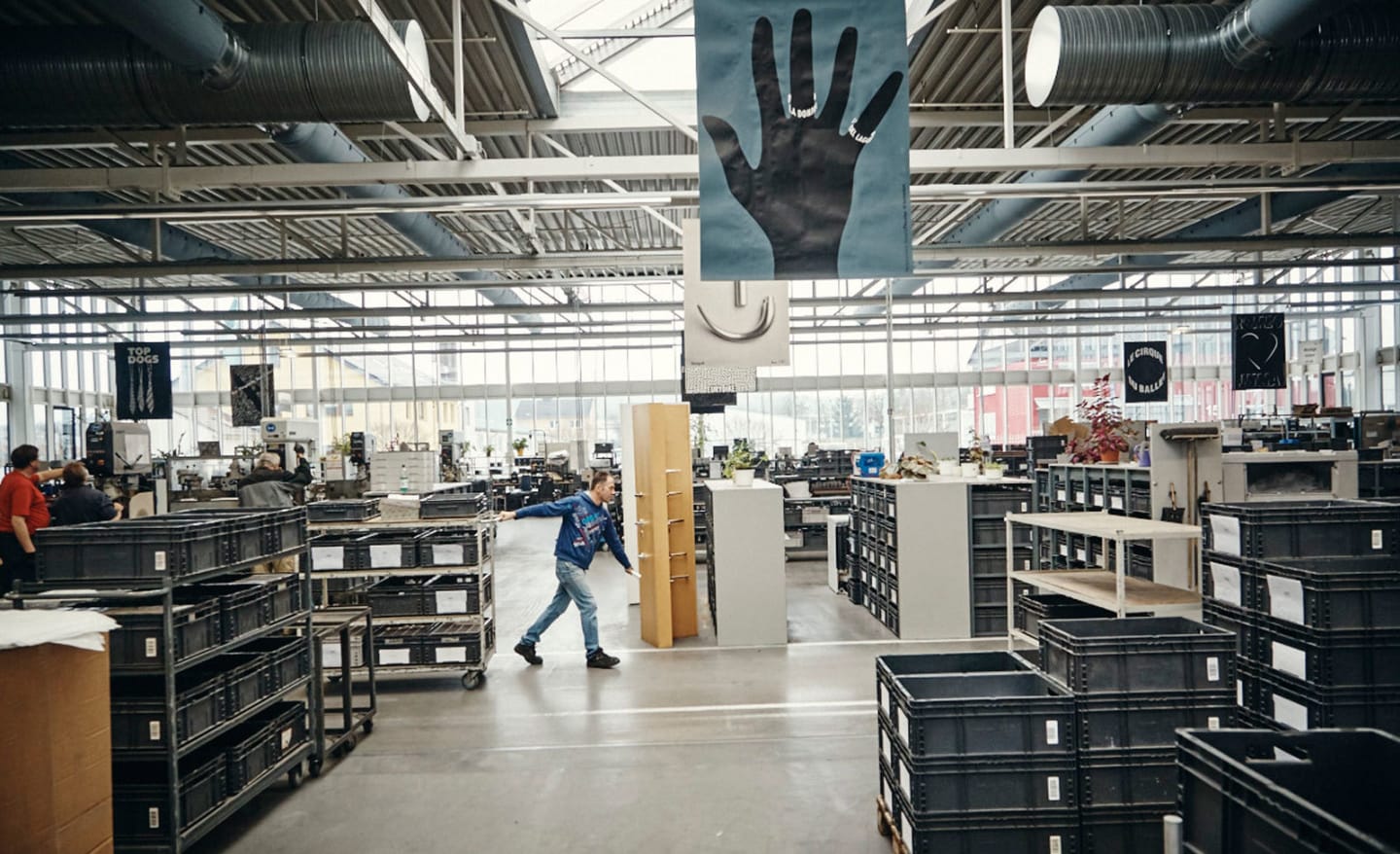
View into the final assembly hall
© Christian Grund
Even though the FSB product catalog is as thick as the Berlin phone book, a large share of production is accounted for by just a dozen successful models. “Our customers’ absolute favorite is the so-called ‘Frankfurt model,’ a simple handle made of two round bars welded together at a miter,” explains Matthias Fuchs, as we come across the FSB 1076 in large quantities on racks during our tour.
This remarkably simple and successful design dates back to architect Robert Mallet-Stevens and thus to the first half of the 20th century, yet it remains entirely timeless.
The Frankfurt Model

No door handle has been copied as often as the mitered model by Robert Mallet-Stevens.

teel models in the FSB range before surface finishing
© Christian Grund
The same can be said of the “Four Principles of Grasping,” which designer Otl Aicher defined for FSB developers back in the 1980s as criteria for handle design: thumb rest, index finger recess, palm support, and grip volume. These are all hallmarks of a successful design, as seen in the model by John Pawson, the master of British minimalism.
Model FSB 1242 draws on Hans Poelzig’s famous Reichsform handle from the 1930s, yet arrives at a new interpretation in refined bronze. Details like these shape a building and give it character. Opinions may differ on door handles, but they are always a statement – one that reveals the ambition of a project’s client, whether in aluminum, stainless steel, or bronze.
This article first appeared in Häuser magazine, issue 3/2016.
Reinterpretation of a Classic

Hans Poelzig’s 1930s Reichsform handle shaped icons like Berlin’s Kino Babylon and Frankfurt’s IG Farben Building. John Pawson distilled this legacy into FSB 1242 – slimmer, more refined, and made for today’s architecture.
FSB 1242 in action


Newsletter
The FSB Newsletter formats keep you informed about product innovations and current topics.